How to Interpret Anion Gap in CKD
What the Anion Gap Measures
The anion gap is a helpful snapshot of acid-base balance from a basic electrolyte panel. It is not a straightforward measurement of a single item. Instead, it is a derived value that helps clinicians look for occult acids in the blood and identify an acid-base disorder that may not be apparent from other numbers alone.
Most of the time, the calculation uses sodium, chloride, and bicarbonate-related values from serum chemistry. Because these measured electrolytes do not account for every charged particle in the bloodstream, the result leaves a “gap” that can point toward acid accumulation or another form of metabolic derangement.
In practical terms, the anion gap gives a diagnostic clue. A higher-than-expected value often suggests extra unmeasured acids. A normal value does not rule out a problem; it may simply mean the disturbance is being balanced by changes such as chloride shift or bicarbonate loss. That is why the anion gap formula is best used as part of a broader clinical interpretation, not as a standalone diagnosis.
Reasons why Anion Gap Differs in chronic kidney disease
Chronic kidney disease alters acid handling in multiple ways. As reduced kidney function advances, the kidneys have a harder time removing daily acid loads and restoring bicarbonate. This can lead to metabolic acidosis, a common complication of kidney failure and renal impairment.
One major reason the anion gap rises is uremia. When the kidneys cannot clear uremic toxins properly, acid-producing compounds accumulate in the blood. This creates acid retention and may produce a high anion gap pattern. In later stages, this can reflect multiple processes at once: retained acids, worsening bicarbonate depletion, and evolving systemic acidosis.
At the same time, chronic kidney disease can also present with a normal anion gap pattern, especially initially in the disease course or when another process is present. This is why an anion gap result should not ever be interpreted in isolation. The overall interpretation framework should include the patient’s kidney function, symptoms, and other acid-base data.
How to Calculate and Work with an Anion Gap Calculator
An Anion Gap Calculator can speed up anion gap calculation and minimize math errors during laboratory analysis. These tools usually ask for lab values such as sodium, chloride, and bicarbonate, and some also include albumin for correction. Using the calculator is helpful, but the result still needs close review.
The basic idea is simple: the calculator estimates the difference between measured cations and measured anions. Because bicarbonate is often the main variable in acid-base interpretation, a low bicarbonate level can immediately indicate a likely metabolic acidosis, even before the anion gap is adjusted. If the calculator includes serum albumin, that is even better, because albumin has a major effect on the expected gap.
To use the result well, ask three questions:
- Is the anion gap increased, normal, or low?
- What is the serum bicarbonate level indicating?
- Does the patient have low albumin or another factor that affects the expected range?
That systematic approach makes the Anion Gap Calculator more than a math tool. It becomes part of the diagnostic evaluation for acid-base disorders in chronic kidney disease.
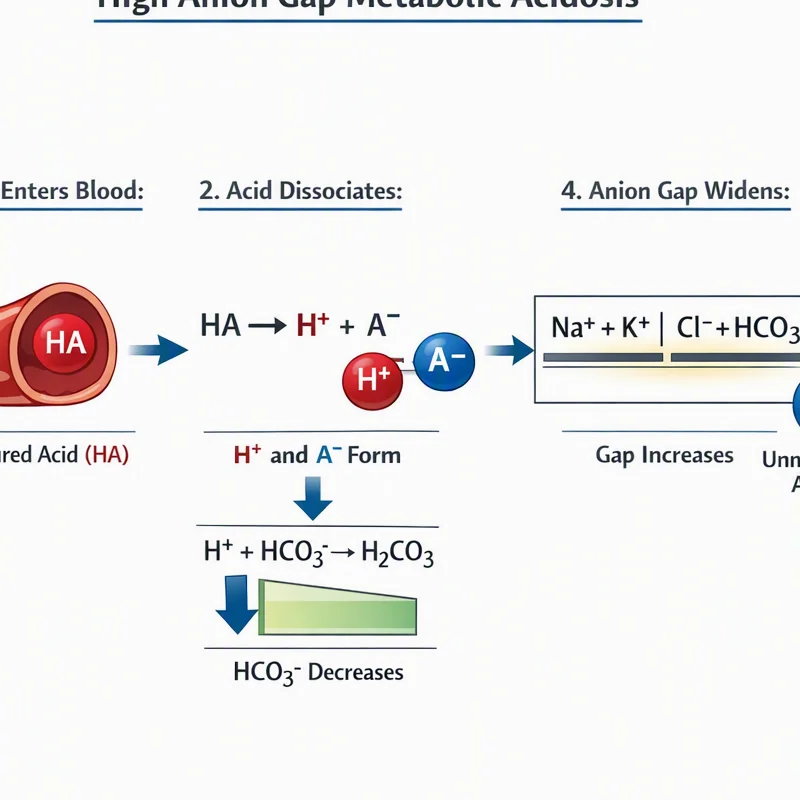
Typical Anion Gap Compared with High Anion Gap in CKD
The contrast between normal anion gap acidosis and high anion gap acidosis is a major part of reading chronic kidney disease labs. In a normal-gap pattern, bicarbonate is lost and replaced by chloride, which is why this is also called hyperchloremic acidosis. In a high-gap pattern, extra acids are added to the blood and the gap widens.
In CKD, a normal gap result can still be meaningful. It may reflect a chloride retention pattern, impaired distal acid secretion, or a concurrent process that lowers bicarbonate without adding large amounts of unmeasured acid. Here is where the broader picture matters. A patient may have a modest bicarbonate reduction and still have clinically important acid-base stress.
By contrast, a high anion gap suggests that acids beyond bicarbonate are accumulating. In chronic kidney disease, this often happens as filtration worsens and lactate, organic acids, and uremic compounds begin to build up. The key is to pair the gap with the clinical story rather than treat it as a yes-or-no answer.
Practical point: A normal anion gap does not mean “no acidosis.” It may simply mean the acidosis is driven by bicarbonate loss or chloride replacement rather than by unmeasured acid accumulation.
Albumin Adjustment and Why It Is Important
Low albumin is common in chronic kidney disease, and it can obscure the true degree of acid-base imbalance. As serum albumin is a important unmeasured anion, a decreased albumin level can make the measured anion gap look falsely normal or only mildly elevated. For this reason many clinicians use a corrected anion gap rather than the raw number alone.
Correcting for albumin increases the practical value of the result. If albumin is low, some of the gap is “missing” just because there is less negatively charged protein in the blood. Correcting for this can reveal an underlying high anion gap metabolic issue that would otherwise be missed.
This is especially true important in chronic kidney disease, where poor nutrition, inflammation, and protein losses can all lower albumin. If you are using an Anion Gap Calculator, check whether it accounts for albumin or whether you need to interpret the value manually. A corrected result offers better perspective for the true acid-base status and decreases the chance of missing metabolic acidosis.
Typical Causes of Increased Anion Gap in CKD
A number of conditions can lead to a high anion gap in chronic kidney disease. The primary is uremia, which indicates poor removal of acid-generating compounds and uremic toxins. As these substances accumulate, they promote metabolic acid retention and intensify the acid burden.
Lactic acidosis is another major cause. It can occur when tissue oxygen delivery is decreased, when infection or shock is present, or when a patient has reduced blood flow from another illness. Since lactate is an unmeasured anion, it can increase the gap rapidly and substantially.
Ketoacidosis also should GI bicarbonate loss NAGMA be considered. Diabetes, prolonged fasting, or severe illness can cause ketone production, introducing acids that increase the gap. Even when CKD is the main diagnosis, a patient can have a second metabolic problem that modifies the anion gap pattern.
Some medications can be involved as well, either by causing lactic acidosis, interfering with metabolism, or producing other toxic acid loads. A medication review is an important part of the workup whenever the gap is surprisingly high.
When the cause is unclear, use the Anion Gap Calculator result as a prompt for more detailed review rather than as the final answer. Elevated values should lead to a focused search for unmeasured acids, worsening renal function, or another acid-base disorder that needs treatment.
When a Normal Anion Gap Still Signals a Concern
A normal anion gap does not exclude medically significant acidosis in chronic kidney disease. In fact, some of the most common CKD-related acid-base problems are in this category. If bicarbonate is low but the gap is not elevated, the most likely explanation is often bicarbonate loss or reduced renal acid excretion without major accumulation of unmeasured acids.
Renal tubular acidosis is a well-known example. This disorder can occur with kidney disease or alongside it and leads to reduced acid secretion or bicarbonate conservation. The result is often hyperchloremic acidosis because chloride rises as bicarbonate falls.
Frequent diarrhea is another common nonrenal cause of normal-gap metabolic acidosis. GI bicarbonate loss can resemble CKD-related acidosis on labs, so the history is crucial. Even in a patient with chronic kidney disease, the cause of acidosis may be extrarenal.
Higher chloride levels can also keep the gap normal while the patient remains acidemic. The pattern may look mild, but it still reflects a real acid-base problem. For that reason, a normal gap should be read together with bicarbonate, renal function, and the clinical setting.
How Medical professionals read the finding in Context
Medical professionals do not read the anion gap alone. They usually look at it alongside the arterial blood gas, serum bicarbonate, pH, and base excess. This provides a more complete picture of the patient’s current acid-base balance and whether there is adjustment for the disturbance.
An arterial blood gas helps determine whether the patient has true acidemia or alkalemia. A low pH supports active acidosis, while the base excess can show how severe the metabolic component is. If bicarbonate is low and pH is also low, that points toward an active acid-base disorder rather than a compensated state.
The pattern of compensation matters too. A low bicarbonate with a near-normal pH may reflect a compensatory response, meaning the body is partially buffering the disturbance. In contrast, a rising gap with falling bicarbonate may indicate worsening metabolic acidosis from progressive kidney dysfunction or another superimposed cause.
In practice, the best interpretation comes from combining the anion gap, the electrolyte panel, and the blood gas results. That is the most reliable diagnostic evaluation strategy for acid-base problems in chronic kidney disease. It helps distinguish whether the issue is mainly acid retention, bicarbonate loss, or a mixed disorder.
Frequently Asked Questions About Anion Gap in CKD
What is a normal anion gap in chronic kidney disease?
A normal anion gap depends on the lab method used, but in chronic kidney disease the exact “normal” number is less important than the pattern. A normal result can still occur with metabolic acidosis, especially if bicarbonate is low and chloride is relatively high. That is why the full acid-base picture matters more than a single cutoff.
Why does the anion gap rise in CKD?
The anion gap rises in CKD because reduced kidney function makes it harder to clear acids. As a result, uremia, uremic toxins, and other unmeasured acids build up in the blood. This causes high anion gap acidosis and is often a sign of more advanced renal impairment or an additional acid-producing problem.
Should you consider the anion gap be corrected for albumin?
Certainly, in many cases it should. Hypoalbuminemia can make the measured anion gap look decreased than it truly is, because albumin is a major unmeasured anion. Albumin correction or a corrected anion gap is especially helpful in CKD, where low serum albumin is common.
Can CKD cause a normal anion gap metabolic acidosis?
Yes. CKD can cause normal anion gap acidosis, especially when the main issue is bicarbonate loss, impaired renal acid excretion, renal tubular acidosis, or hyperchloremic acidosis. A normal gap does not rule out a real acid-base problem, so it should always be paired with serum bicarbonate and blood gas data.
When should an elevated anion gap in CKD prompt further testing?
An elevated anion gap should prompt further testing when it is new, increasing, or out of proportion to the degree of CKD. Additional evaluation is important if there is concern for lactic acidosis, ketoacidosis, medications, or severe uremia. An arterial blood gas, pH, and base excess can help clarify how severe the disturbance is and whether urgent treatment is needed.